



The Sahel is warming 1.5 times faster than the global average. That one fact now drives much of the region’s development agenda.
Rainfall has become unpredictable. Seasons that were once reliable enough for pastoral planning now swing between floods and prolonged droughts, sometimes in the same year. The 2024 floods across Niger, Chad, and Mali displaced over 1.5 million people. Months later, the same areas ran short of water.
For development professionals in the region, climate adaptation is no longer a thematic niche. It’s the backdrop to almost every project.
Where the funding goes
Climate adaptation financing for the Sahel has grown sharply, though it still falls short of estimated needs. Here are the main sources in 2026:
Green Climate Fund (GCF). The GCF has approved over $500 million in projects touching the Sahel since its inception, with several major new approvals in 2025. The $195 million Senegal River Valley Climate Resilience project, covering Mauritania, Senegal, Mali, and Guinea, is one of the largest cross-border adaptation initiatives in Africa. It focuses on water resource management, flood protection, and sustainable agriculture along the river basin.
World Bank climate co-benefits. The World Bank now requires that at least 35% of its financing delivers climate co-benefits. In practice, most new projects in the Sahel include a climate component: climate-smart agriculture in a food security project, or climate-resilient infrastructure standards in a road program. The $82.5 million DREAM project in Mauritania is a good example: framed as a drylands resilience program, it integrates pastoral management, early warning systems, and ecosystem restoration.
Adaptation Fund. Smaller but highly targeted, the Adaptation Fund backs community-based projects across the Sahel, with a focus on local ownership. These tend to fall in the $5 to $10 million range but come with strong local implementation structures.
Bilateral climate finance. Germany (through GIZ and KfW), France (through AFD), and the EU have all increased their climate-adaptation portfolios in the Sahel. The EU’s Global Gateway initiative includes major renewable energy and climate resilience components for the region.
What the projects look like on the ground
Climate adaptation in the Sahel isn’t one thing. It’s a constellation of interventions that look very different depending on the context:
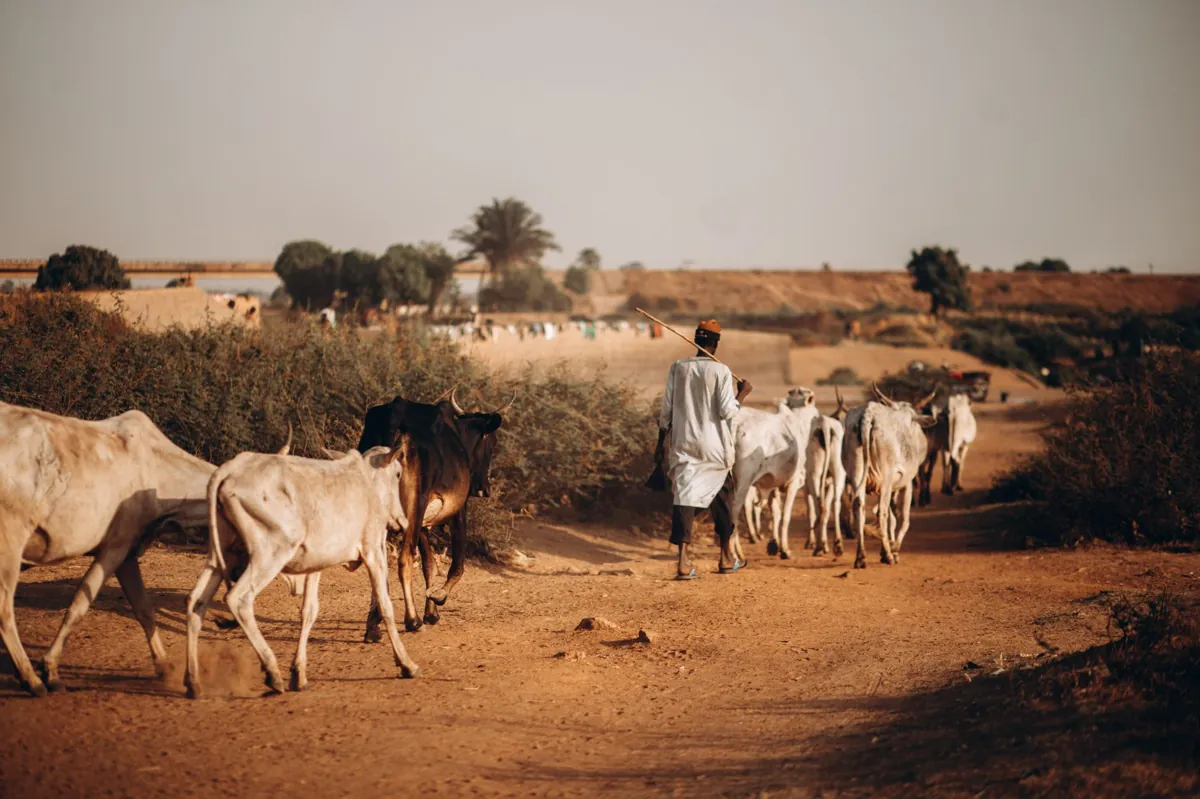
Pastoral mobility and livestock. For the millions of pastoralists in the Sahel, adaptation means protecting transhumance corridors, improving livestock health services, setting up early warning systems for pasture conditions, and creating alternative livelihoods for years when the rains fail. Projects like the Regional Sahel Pastoralism Support Project (PRAPS) have been working on this for a decade.
Water infrastructure. From small-scale solar-powered pumping stations to major river basin management programs, water sits at the center of most adaptation strategies. The hard part is maintaining infrastructure in remote areas with limited institutional capacity: a problem technology alone doesn’t solve.
Climate-smart agriculture. Techniques like zaï pits, half-moons, and agroforestry have been practiced in the Sahel for generations. Current projects are scaling them up with improved seed varieties, weather-indexed insurance, and digital advisory services. Across the Sahel, the “Great Green Wall” initiative is gradually shifting from a tree-planting program into a broader landscape restoration and livelihood framework.
Urban resilience. Sahelian cities are growing fast: Nouakchott, Niamey, Ouagadougou, and N’Djamena are among the world’s fastest-growing. Urban adaptation is becoming a priority in its own right. Flood management, heat mitigation, and water supply in expanding informal settlements all call for specialized expertise.
The consulting opportunity
For development consultants and bureaux d’études in the region, climate adaptation is the largest and most sustained source of project demand for the next decade. The skills in demand include environmental and social impact assessment, hydrological modeling, participatory vulnerability assessment, GIS and remote sensing for landscape monitoring, and institutional capacity building for climate governance.
The obstacle is visibility. Climate projects are funded by different mechanisms, implemented by different agencies, and published on different platforms. A GCF-funded project in the Senegal River Valley might be implemented by a UN agency, co-financed by a bilateral donor, and require subcontracted expertise published on yet another procurement portal.
Mapping all of this, knowing which projects exist, who’s funding them, what expertise they need, and when opportunities open, is exactly the kind of intelligence infrastructure ICOpedia is building for the Sahel.
The climate crisis in the Sahel is accelerating. So is the response. The professionals who can keep up with both will have the edge over the next decade.

